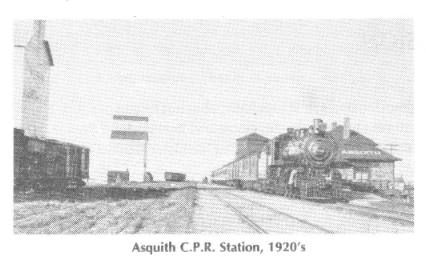
Environ is a siding or hamlet on a branch of the C.P.R.
railroad line, it is ten miles northwest of Asquith. It formerly
consisted of two elevators, a store and service station (two
for a while), but now all are closed and the branch line is in
danger of meeting the same fate.
A spur line was built from Asquith to what was known as
"The Pit" in about 1908 to get gravel for ballast in building
the C.P . R. from Winnipeg to Edmonton, that's the C.P . R.
line that passes through Asquith. For many years the
hamlet was known as the Pit, some of the settlers wanted
to name it Gravelbourg but that name was already taken
so in the late 1920 's when the branch line was built to
Baljennie the C.P. R. came up with the name Environ.
When the spur line was built about 1908 the railway
spotted cars in the gravel pit and the farmers drove their
wagon loads of grain up on the banks of the pit and filled
the cars by running the grain down chutes by gravity into
the boxcars. They could load 17 cars at a time. This bank
of the gravel pit was supposed to be the longest loading
platform in North America. There had been as many as 80
teams and wagons in at one time. There was always a mad
scramble for cars as the trains just came in from the time
harvest was completed until the first snowfall, the farmers
helped each other and took turns with the freight cars. The
story is told of one farmer who loaded a car after supper
one night with help of his neighbors. This method of
loading cars went on for some time until a grain company
put in a scale to weigh the grain, that meant that more than
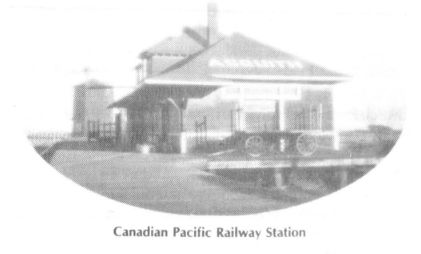
one farmer could load grain in the same car. Canadian Pacific Railway
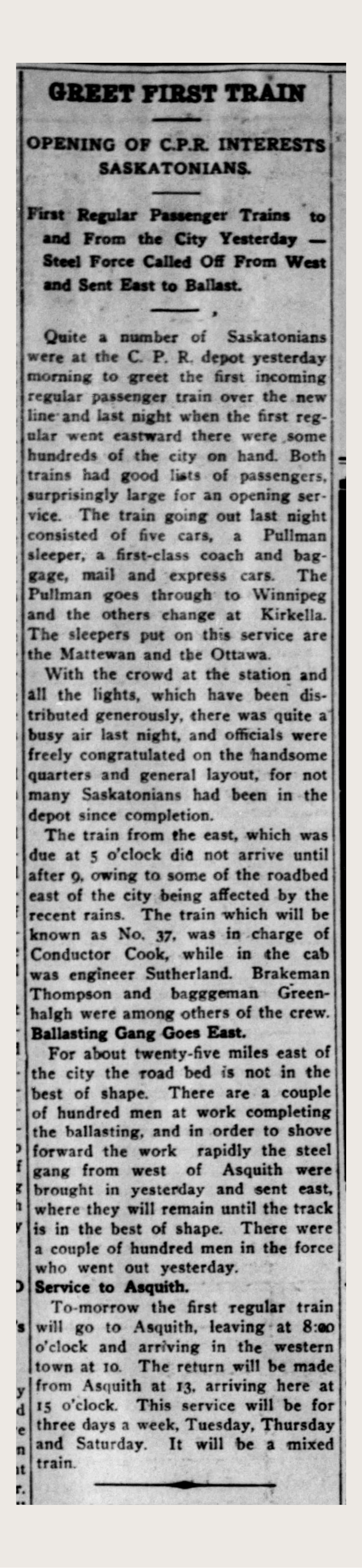
The main line track through Asquith to Saskatoon was
placed in operation Mar. 25, 1908.
From Asquith to Wilkie was operational Oct. 28, 1908.
Regarding the tracking built there were 2,700 feet of siding built in 1906 .
Then 1,600 feet of elevator track was
also built in 1906. As well in 1928, 2,395 feet of storage track was built.
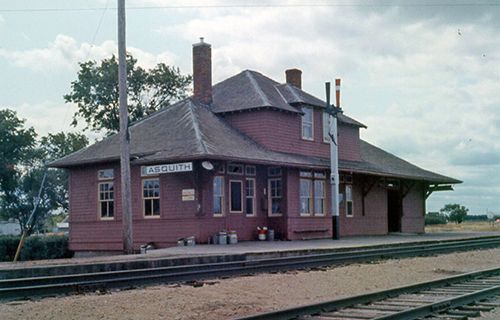
A 58x22 foot station was built in 1906 and sold June 15, 1979 ,
where it was relocated
6km north and 3km west of town, then 1km along the 374 trail.
Fun Fact:
Our property and the train station
was bought from a relative of actor David Carradine,
who is said to have frequently come to live in this train station as a "nuclear shelter".

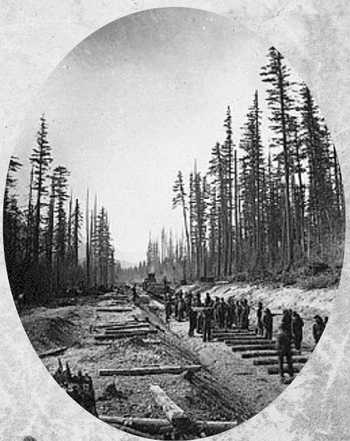
Canadian Pacific Railway Crew laying tracks at lower Fraser Valley, 1883
Building the railway took almost five years, between
1881-1886. The Canadian Pacific Railway began its westward expansion from Bonfield, Ontario (previously called Callander Station), where the first spike was driven into a sunken railway tie. It was presumed that the railway would
travel through the rich "Fertile Belt" of the North Saskatchewan River Valley and cross the Rocky Mountains via the Yellowhead Pass, a route suggested by Fleming based on a decade of work. However, the CPR quickly discarded this plan in favor of a more southerly route across the arid Palliser's Triangle in Saskatchewan and via Kicking Horse
Pass and down the Field Hill to the Rocky Mountain Trench.
This route was more direct and closer to the Canada–US border, making it easier for the CPR to keep American railways from encroaching on the Canadian market.
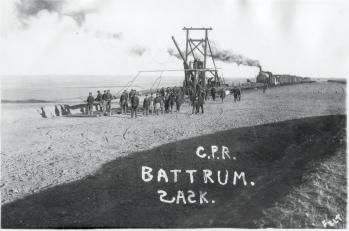
Construction of the CPR “Empress Line,” northwest of Swift Current, 1911
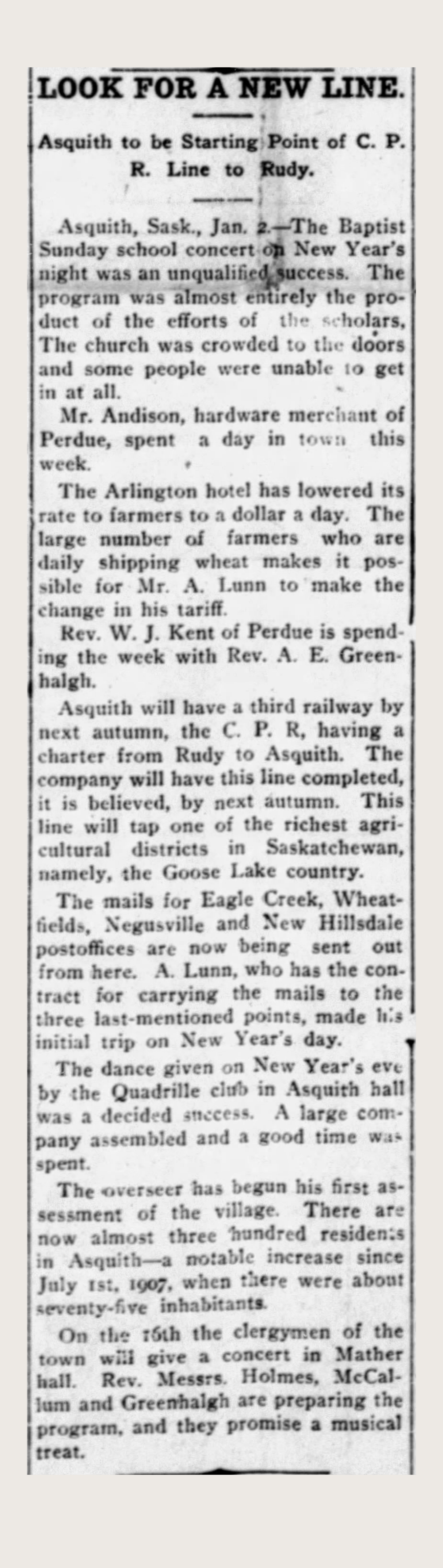
The CPR line ran through what is now Saskatchewan in
1882-83. In addition to its mainline running from east to west, the CPR
branched northward: it accomplished this by purchasing the Qu’Appelle-Long Lake
and Saskatchewan Railroad and Steamboat Company. The Regina to Prince
Albert line was completed in 1889–90. In answer to persistent demands by
settlers and businesses from communities adjacent to the railway, the CPR
proceeded cautiously, building feeder lines only when there were prospects for
profitable returns—if not immediately, then at least in the foreseeable future.
The CPR linked Canada from east to west when the last spike was driven by
Donald A. Smith (later Lord Strathcona and Mount Royal) at Craigellachie,
British Columbia on November 7, 1885.
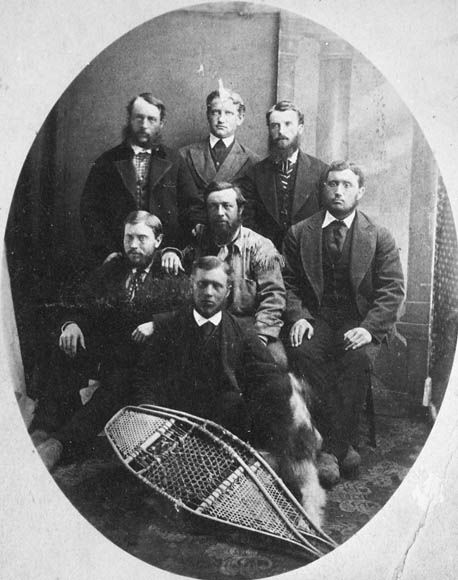
Unidentified engineers of the Canadian Pacific Railway Survey, 1872
The Canadian Pacific Survey or Canadian Pacific Railway Survey comprised many distinct geographical surveys conducted
during the 1870s and 1880s, designed to determine the ideal route of the Canadian Pacific Railway. Although much of the survey's activity focused on locating suitable mountain passes through the Canadian Rockies, Selkirk Mountains, Monashee Mountains, Canadian Cascades and Coast Mountains of western Canada,
locating the
best route across the rugged terrain of the Canadian Shield north of Lake Superior was
also a primary goal. The survey played an important role in the exploration of Canada,
especially in the mapping
of hitherto-uncharted parts of British Columbia.